AI Backlink Outreach: What an Agent Does All Day, and Our Real Numbers
An AI backlink outreach agent finds pages on your topic, finds the editor, writes a pitch about that page, sends it from your own domain and drafts the replies. You approve sends and decide anything involving money or a link.
What it automates cleanly: finding sites, verifying addresses, writing, sending, following up.
What it does not: place a link, agree a price, or fix a page nobody wants to cite.
What it costs: $79 to $149 a month for the agents; $300 for the managed version; $2,500 and up for an agency doing the same work by hand.
Between 7 March and 17 September 2026 MentionAgent emailed 19,184 domains for 31 customer workspaces. 1,464 replied with a human message, 7.6% of domains. The median reply took 3.2 hours.
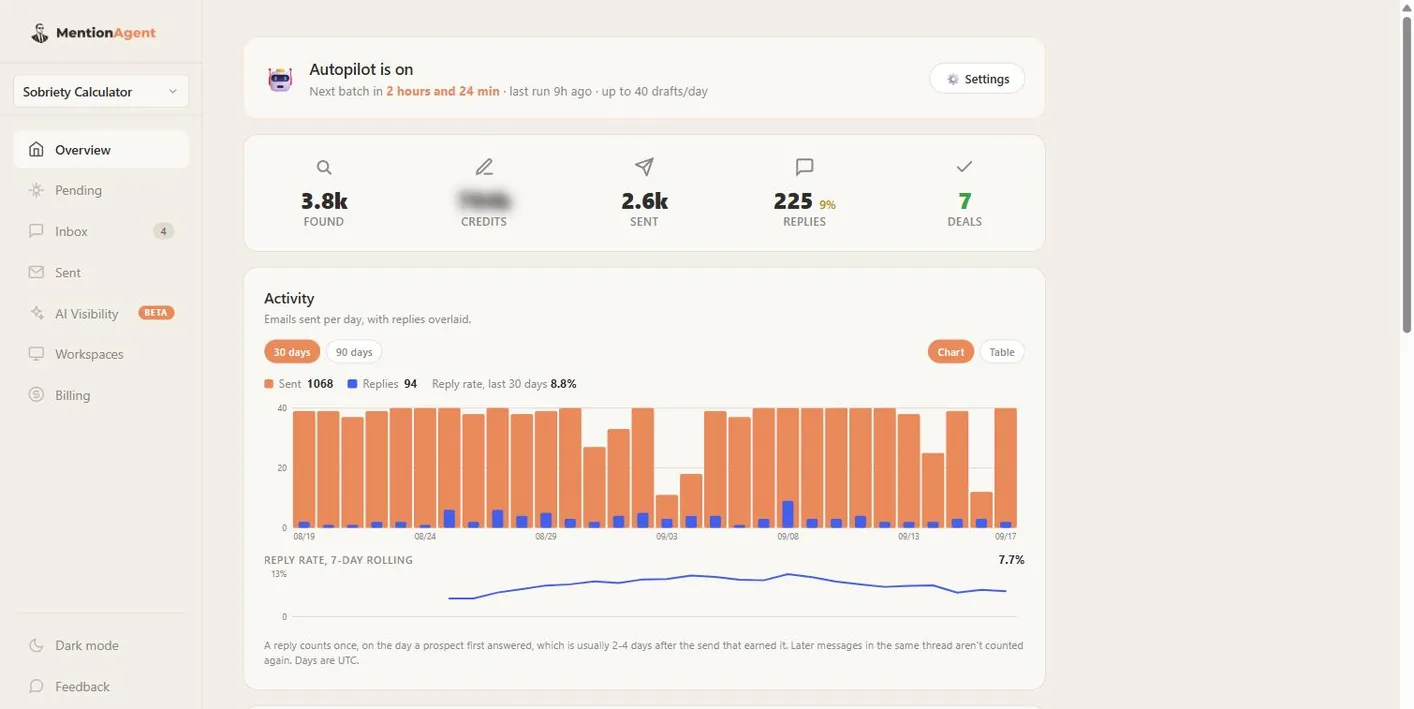
The last 30 days alone: 16,994 sites found, 15,744 passed qualification, 16,171 contacts found, 12,144 drafts written, 10,094 emails sent.
Bounces: 465 of 20,207 attempted sends, 2.3%.
Counted from our production database on 17 September 2026. Replies are counted per domain, not per address, because six in ten replies come from a different address than the one we wrote to.
Link building used to be split across three roles: a prospector finds sites, an outreach specialist writes and sends, a closer negotiates the placement. An AI backlink outreach agent collapses those into one loop and removes the operator from most of it. That is the pitch every vendor makes, including us. What the pitch leaves out is what the loop produces when it runs for real, so this page is built from our own production database rather than from a benchmark someone else published.
We build an AI backlink outreach agent and run it on our own sites, so the numbers below cut both ways. Where the agent looks bad, that stays in. If you want the wider map of tools that are not agents, the best link building tools roundup covers platforms, prospecting tools and agencies side by side.
What an AI backlink outreach agent does in a month
These are the 30 days to 17 September 2026, across the 20 workspaces that sent at least one email in that window. Every row is a count from the same database the dashboard reads.
| Step | 30-day count | What happened to the rest |
|---|---|---|
| Sites found by search | 16,994 | Search queries per workspace, moved outward as each set goes stale |
| Passed qualification | 15,744 | 1,030 dropped for being DR 85+ publications that do not answer cold email; 63 dropped as unsolicited inbound; the rest for fit |
| Contacts found | 16,171 | More than one address on some sites; a named editor where one is published, a role inbox where not |
| Drafts written | 12,144 | Some sites reach the draft stage days later; some are held for a verifier verdict |
| Emails sent | 10,094 | 280 drafts discarded by customers at review, 164 bounced, the rest queued behind the daily cap |
| Agent runs completed | 833 | About 1.4 runs per workspace per day, each producing up to the workspace's draft cap |
Two things in that table are easy to miss. First, customers discarded 280 of 12,144 drafts, which is 2.3%. That is the approval step doing its job, and it is also the answer to "how much do I need to babysit it". Second, the agent found more contacts than it qualified sites, because it keeps a named person and a role inbox when both are published and picks the better one at send time. Of the 26,014 addresses we had collected by 3 September, 39% were role inboxes, and dropping those would remove almost half the reachable pool.
One real pitch, annotated
Most pages about AI outreach show you a template. Here is an email the agent actually sent on 26 August 2026 from one of our own sites, to the role inbox of a self-help blog, with what each line is doing and what happened afterwards in the same thread.
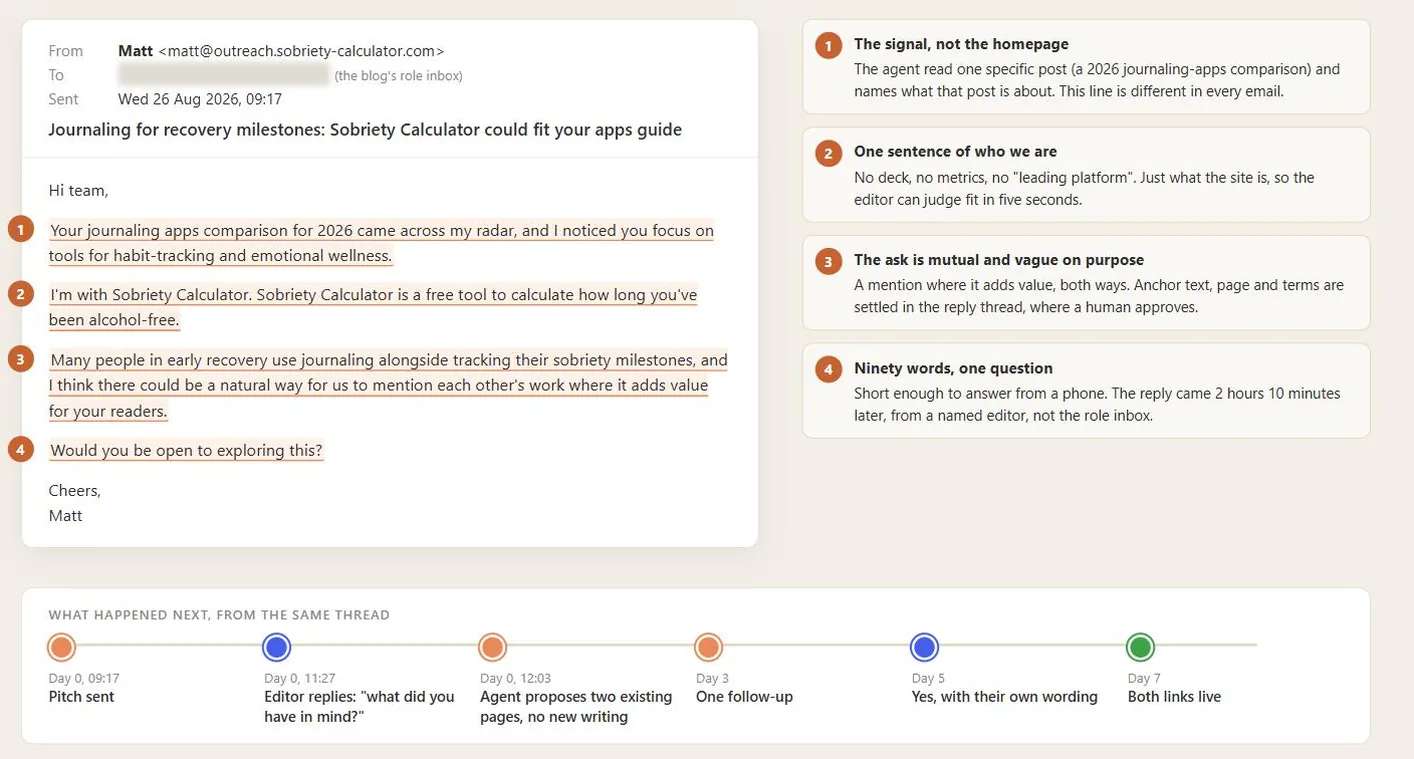
The first line is the whole method. The agent had read a specific post, a journaling-apps comparison, and named what that post was about. It did not say "I love your blog". Personalization that comes from a page the agent actually read reads like a human wrote it; personalization that comes from a template with the site name inserted reads worse than none, because it signals effort that is not there.
The ask is deliberately loose. "Mention each other's work where it adds value" leaves the page, the anchor and the terms for the reply thread, where a human is in the loop. Two hours and ten minutes later a named editor answered from their own address, not the role inbox, asking what we had in mind. The agent proposed two existing pages so nobody had to write anything new, nudged once on day three, got a yes on day five with the editor's own wording, and both links were live on day seven.
One thread is an anecdote, not a rate. The rates are in the next section.
What replies look like, at 19,184 domains
The thing an agent cannot fake is what comes back. Between 7 March and 17 September 2026, 1,464 of the 19,184 domains we emailed answered with a human message, after stripping auto-replies, out-of-office notices and delivery reports. That is 7.6% of domains. Timing, from the pitch to the first human reply:
| Share of replies | Arrived within |
|---|---|
| 25% | 6 minutes |
| 50% | 3.2 hours |
| 75% | 24 hours |
| 90% | 88 hours |
Read the fast quartile with care: replies inside a few minutes are often an editor's assistant, a ticket acknowledgement our filter missed, or a "not interested". The useful reading is the other end. If nothing has come back after four days, it is not coming, and a second follow-up will not change that. The agent sends one follow-up and stops.
Of the replies the agent classified, roughly half were positive or negotiating (interested, asking for details, proposing a deal, countering our proposal), one in five was a request for payment, and one in five was a decline. The paid offers are the ones the agent is not allowed to answer on its own; they land in the inbox marked for a human.
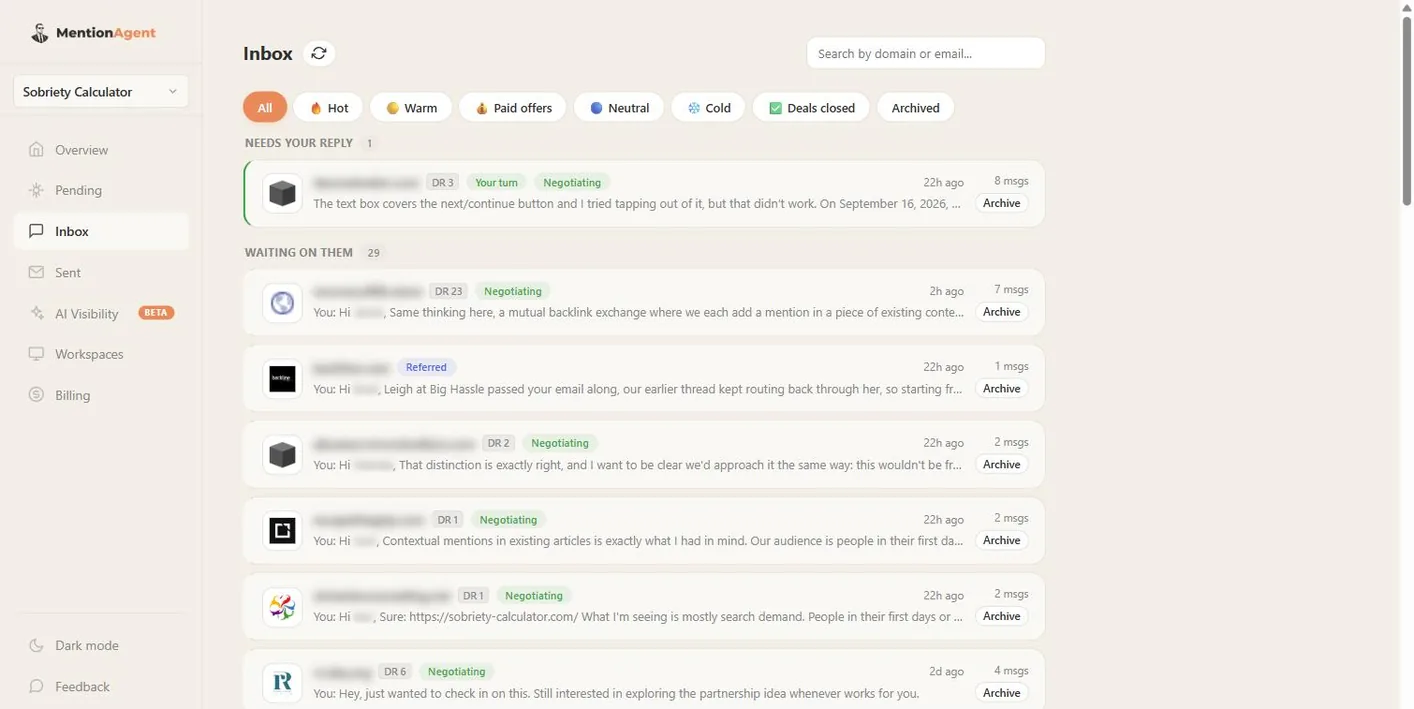
One more measurement that changed how we count. We pitch [email protected]; a named person answers from [email protected]. On 15 September 2026, 1,358 of the 2,289 contacts with a human reply on the platform had no outbound email at all, because the reply came from an address we never wrote to. Any tool that reports reply rate per address you emailed undercounts by about a fifth. Count per domain.
The three shapes of "AI" in outreach tools
Most tools call themselves AI-powered. The label covers three different products:
| Shape | What the AI does | What you still do | Examples |
|---|---|---|---|
| AI rewriting | Varies the wording of a template you wrote | Build the list, build the campaign, send | The "AI" toggle in most cold email tools |
| AI-assisted | Suggests prospects, writes icebreakers from a prospect's content, verifies addresses | Configure campaigns, review prospects, approve copy, manage sequences | Respona, Pitchbox, Linkee |
| Agent | Picks prospects, writes the full pitch, sends, follows up, drafts replies | Approve, and decide on money | MentionAgent, AutoBacklinks, BacklinkGPT |
The line between the second and third row is who owns the campaign. In an AI-assisted tool you still build one; the AI makes each step faster. An agent starts from your domain and a description of your audience and comes back with drafts. The agentic outreach entry in our glossary has the longer definition.
AI backlink outreach agents compared
Prices read on each vendor's public pricing page on 17 September 2026. We build MentionAgent; the others we have evaluated from the outside. Screenshots are the vendors' homepages on the same day.
| Tool | Starting price | Shape | Sends from | Approval |
|---|---|---|---|---|
| MentionAgent | $99/mo, one inbox | Agent | A subdomain of your own domain | Dashboard, MCP, or auto-send |
| AutoBacklinks | $79/mo | Agent, credit-metered | Your own mailboxes, 5 on the Growth plan | Dashboard; MCP server included |
| BacklinkGPT | $149/mo | Agent | Not stated on the pricing page | Dashboard |
| Linkee | $80.83/mo, yearly plan | AI-assisted campaigns | Linked email accounts, 3 to unlimited | Campaign review |
| Metaflow | $99/mo | Agent platform, backlinks are one agent | Not stated on the pricing page | Task review |
| Backlinker AI | $300/mo | Managed service via journalist-request platforms | Their team | None needed |
| Respona | $99/mo | AI-assisted | Your connected inbox | Campaign review |
| Pitchbox | $165/mo, annual | AI-assisted, enterprise | Your connected inbox | Campaign review |
MentionAgent
Does: the whole loop in the table above, for contextual mentions in existing posts rather than guest posts. Sends from a warmed subdomain of your own domain at up to 40 new emails a day per inbox. Reads replies, drafts responses, escalates anything involving money. Also runs from Claude Code, Cursor, ChatGPT or any MCP client.
Price: $99/mo for one sending inbox, $179 for two, $329 for four, $629 for eight. No credits and no per-link fees.
Good: nothing to configure beyond a description of your site; every number on this page is what it produced. Bad: one campaign type, so no guest-post or broken-link modes; volume is capped by the inbox count rather than by how much you pay.
AutoBacklinks
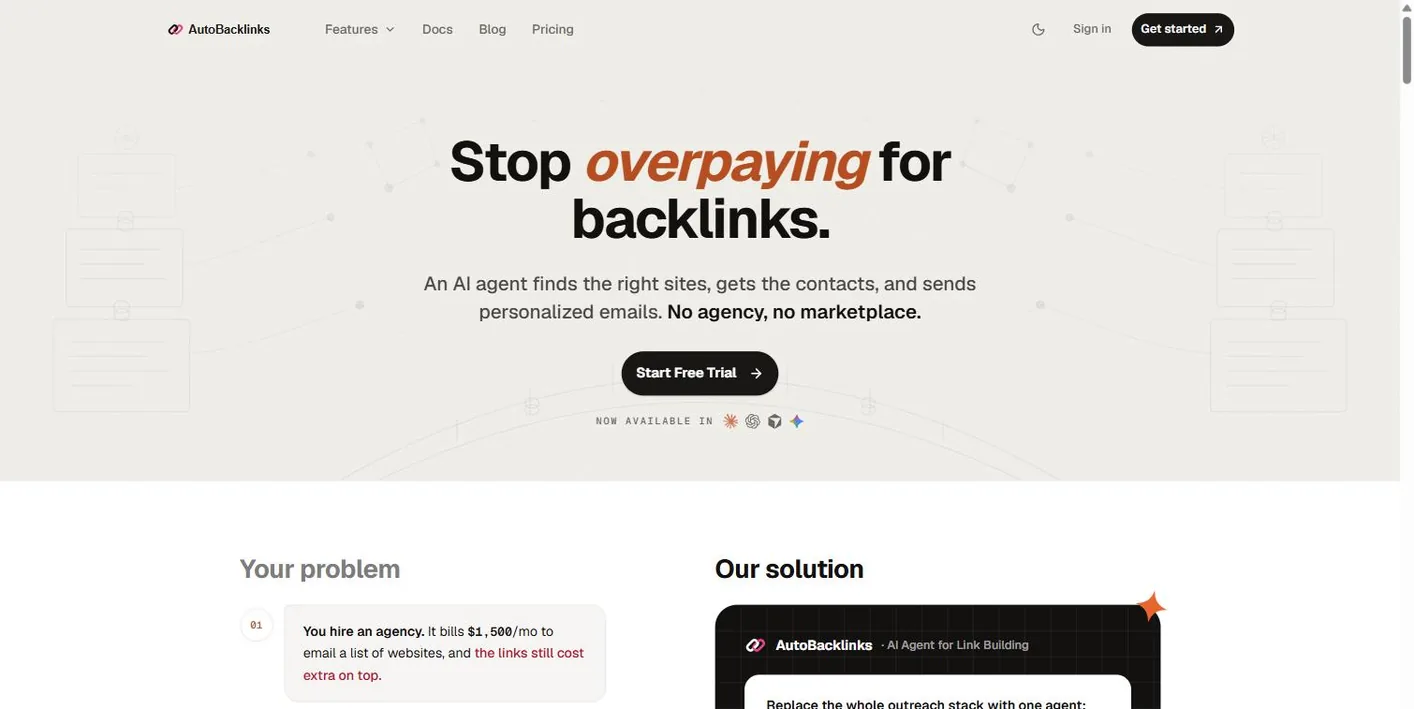
Does: guest posts, listicles, product reviews, directory submissions and a competitor backlink scan, run by an agent with an MCP server. Plans are metered in credits (2,500 on Starter) with a stated email volume per month.
Price: $79/mo Starter, $179 Growth, $399 Scale. Seven-day trial with 120 credits.
Good: the widest set of campaign types among the agents and the most explicit pricing page. Bad: credits, so a busy month costs more; DR 23 domain, so the company is young.
BacklinkGPT
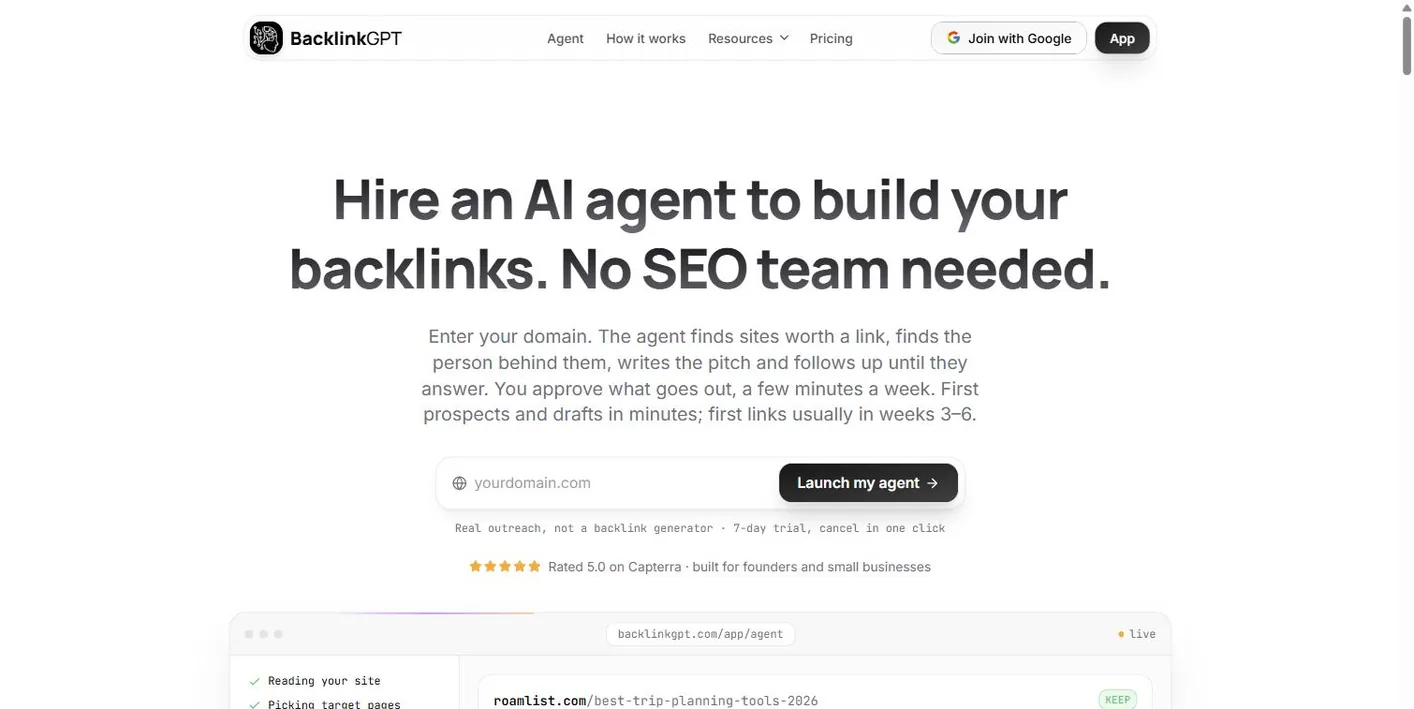
Does: enter a domain, the agent picks target pages, seeds keywords, scans SERPs and competitors, scores each prospect and drafts the pitch. Built for founders without an SEO team, and the homepage says so.
Price: $149/mo Starter, $399 Growth, $999 Scale.
Good: the clearest live demonstration of an agent's reasoning on any homepage in this list. Bad: the most expensive entry tier of the agents; sending infrastructure is not described.
Linkee
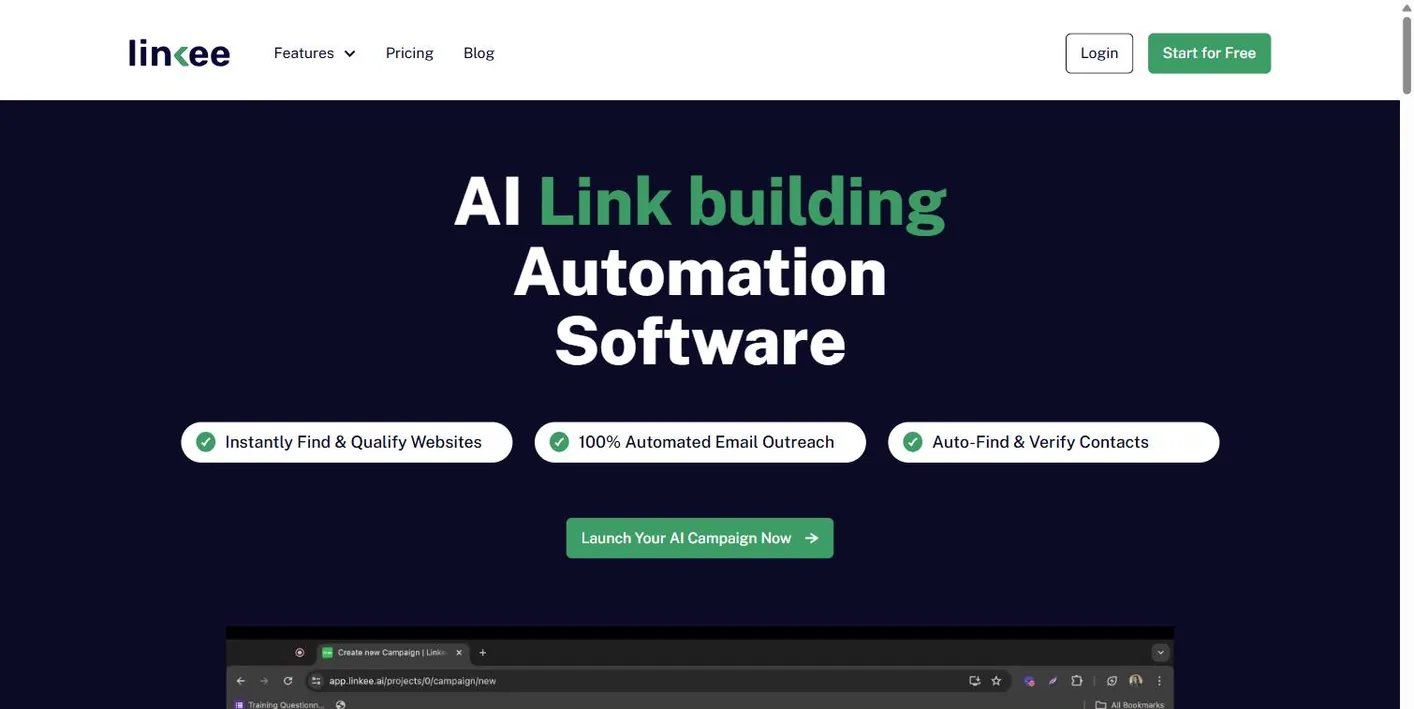
Does: AI campaign builder, website qualifier, email finder and verifier, outreach sequences from your linked accounts. Closer to an AI-assisted platform than an agent: you create the campaign, the AI fills it.
Price: $80.83/mo Essential, $164.17 Pro, $298.33 Agency, all shown on the yearly toggle. Free trial without a card.
Good: generous credit allowances and Ahrefs metrics inside the qualifier. Bad: the homepage demo still shows a trial ending in July 2024; you are still the campaign operator.
Metaflow
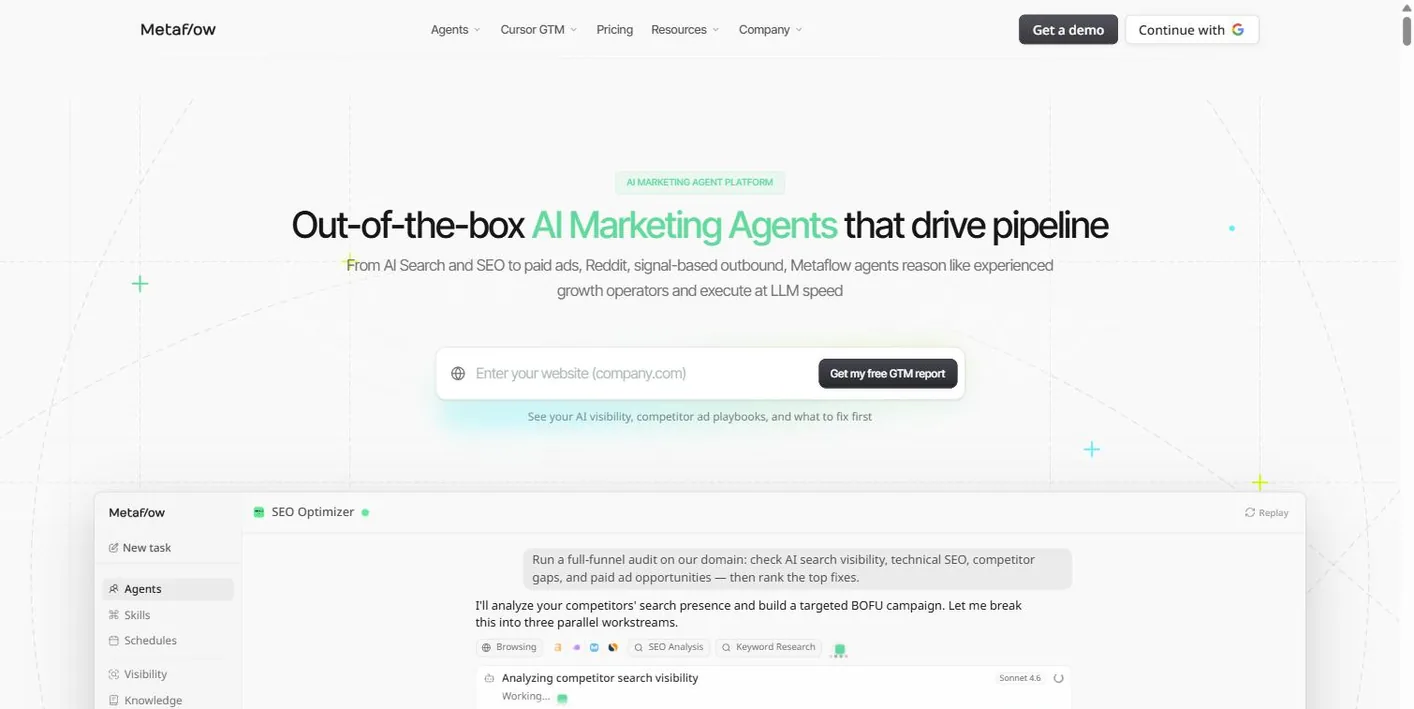
Does: a roster of marketing agents (AI search visibility, paid ads, blog posts, outbound) of which backlink outreach is one. Buy it if you want the roster; the backlink agent alone is not the product.
Price: $99/mo Solo Growth, $299 Scale Pro, credits from $5 without a subscription.
Good: one bill for several jobs. Bad: outreach depth is thinner than the single-purpose agents, and the pricing page does not say where emails send from.
Backlinker AI
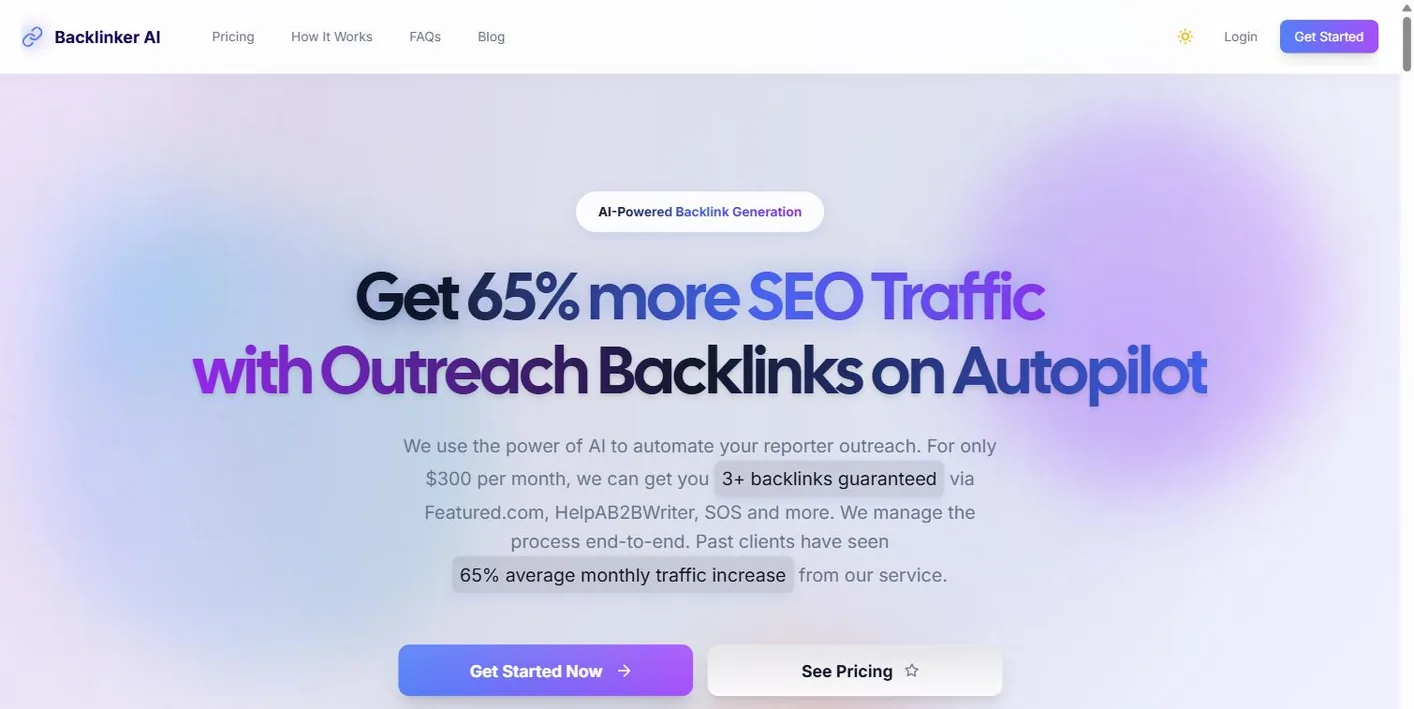
Does: answers journalist requests on platforms such as Featured.com and Help a B2B Writer on your behalf, with AI drafting the responses. A managed service with a guarantee, not software you operate.
Price: $300/mo, three or more links guaranteed.
Good: the only entry with a stated minimum outcome. Bad: the links come from quote roundups rather than from editors who chose your page, and the 65% traffic claim on the homepage is theirs, not something we can check.
See what the agent drafts for your site
MentionAgent finds the posts, finds the editor, writes each email against the page it read and sends from your own domain. You approve in the dashboard or from Claude Code. $99/month, one sending inbox.
Start Getting Mentioned On AutopilotWhat still breaks, measured
Every vendor page in this category, including ours, would rather skip this section. These are the three failures we have measured in our own runs, not the ones we assumed.
The prospect pool runs dry, quietly. An agent that re-runs the same search queries produces steadily fewer drafts per run while looking healthy. When we measured it in September, our newer workspaces' yield had fallen from 0.48 usable sites per search to 0.10, because the agent never paged past the first 30 results and reused one query template. The fix was structural: track which queries are spent, page deeper, and push the query set outward into audience terms and adjacent topics rather than repeating product terms. If a vendor cannot tell you how their agent avoids re-finding the same 200 sites, it does not.
Personalization is bounded by what the agent read. A pitch built from a homepage skim is generic, and generic-with-a-name reads worse than a plain template. The pitch above worked because the agent had a specific post and a one-line note about why it fit. When the note is weak the draft is weak, which is why discarding at review matters more than most people expect.
Role inboxes forward, and the reply lands somewhere you are not looking. Six in ten replies come from an address the agent never emailed. A tool that threads by address instead of by domain shows those as new inbound and loses the context of the pitch. Ours merges them onto the original prospect; it did not always, and the reply rate looked 20% worse than it was until it did.
Can an AI agent do broken link building?
Partly, and the honest split matters because "AI broken link building agent" is a search people run. Finding a dead outbound link on a page is a crawl: fetch the page, follow each link, record the 404s, look the dead URL up on the Wayback Machine to see what it used to say. That automates cleanly and there are free crawlers that do it. The judgement is the hard half: is your page a fair replacement for what died, or merely a page you would like linked? An agent that cannot answer that sends the editor a list of their own broken links plus an unrelated URL, and the editor fixes the links without adding yours.
Most of what ranks for that phrase is a workflow demo or an agency's service page. MentionAgent does not crawl for dead links at all: it pitches live, relevant posts for a contextual mention, which is the variant of outreach that our reply data comes from. If broken link building is the campaign you want, AutoBacklinks lists it as a mode, and the how to build backlinks guide covers running it by hand.
Your own mailbox, not a sending pool
Where the email leaves from decides whether any of the above matters. An agent that sends from a shared pool inherits every other customer's reputation; an agent that sends from your primary domain can burn it. MentionAgent provisions a subdomain of your domain (outreach.yourdomain.com) with its own mailbox, warms it, and caps new sends at 5 a day in week one, 10 in week two, 20 in week three and 40 from week four. Follow-ups and replies sit on top of that cap.
Of the 20,207 emails attempted between 7 March and 17 September 2026, 465 bounced, which is 2.3%. Three rules got it there, and two are counterintuitive: verify each address right before sending rather than when the list is built, because addresses rot in between; block anything a verifier grades risky, not only invalid; and never retry a soft bounce, because when we measured our retries, more of them hard-bounced than delivered. The cold email deliverability guide goes through each of those.
What the agent never does without you
- Send, unless you tell it to. Drafts wait in the Pending page, or in your own agent over MCP, until you approve them. If you would rather not review, auto-send lets batches go out inside the daily limit; 280 of 12,144 drafts were discarded at review last month, so most customers keep the step.
- Agree a price. One in five replies asks for money. Those threads are labelled and left for a human. The agent can say "we do not pay for placements" if you have told it so; it cannot say "yes, $150".
- Place a link. The line between an outreach agent and link spam is that an outreach agent asks a person who can say no. Anything that inserts a link without an editor deciding to (directory blasts, comment injection, private blog networks) is a different product with a different risk, and it is why "automated link building" is a phrase people say with suspicion.
- Reply to a hostile inbound. Over MCP, the reply tool has no recipient parameter by design: the address comes from the thread, so an agent that has read a manipulative email has nowhere to redirect a reply to.
Free tools for the parts you still check by hand
Whichever shape you pick, a few checks stay manual. These run in the browser and do not need an account:
- Cold email grader: paste a draft and get it scored on length, ask clarity and the phrases that trip spam filters.
- Spam word checker: the words and patterns mailbox providers weight against you.
- Email verifier: check an address before you send to it, which is the single change that moved our bounce rate most.
- Subject line tester: length and wording checks for the one line an editor sees before opening.
- Backlink ROI calculator: what a placement is worth against what an agent, a freelancer or an agency costs.
Which shape to pick, in 30 seconds
- Founder or small team, no SEO hire, a site with something worth citing: an agent. MentionAgent if you want contextual mentions from your own domain; AutoBacklinks if you want guest-post and listicle modes.
- You want to run several campaign types and keep control of every list: AI-assisted. Respona for content-led prospecting, Linkee for the qualifier and verifier, Pitchbox if you are an agency with three or more people on it.
- You want a number of links promised on a contract: a managed service. Backlinker AI at $300 with three links guaranteed, or a managed link building service with editorial placements.
- You have under a few hundred relevant sites in your niche: do it by hand with BuzzStream at $24 and the link building email templates. The pool is small enough that a person will do it better.
- Your page is not something an editor would cite: none of the above yet. Fix the page first; no amount of outreach changes a no.
The same placements feed AI visibility. The blogs an agent pitches for a backlink are the ones AI engines retrieve from, so the reply data above is also the input to our generative engine optimization guide. Solo founders moving into AI services often want a framework before pitching clients, and NoBossAI's guide to starting an AI micro-agency covers positioning and packaging before the outreach starts.
Frequently asked questions
What is an AI backlink outreach agent?
Software that runs the link building outreach loop without an operator: it searches for pages on your topic, qualifies the site, finds and verifies an editor's address, writes a pitch that references the specific page it found, sends from your own domain, follows up once, reads the reply and drafts the response. A human approves sends and decides anything involving money or a link placement.
What reply rate does AI backlink outreach get?
Across 19,184 domains MentionAgent emailed between 7 March and 17 September 2026, 1,464 replied with a human message, which is 7.6% of domains. The median first reply arrived 3.2 hours after the pitch and nine in ten arrived within 88 hours. Reply rates vary a lot by niche and by how well the prospect list is targeted.
How much does an AI backlink outreach agent cost?
Read on 17 September 2026: MentionAgent is $99 a month for one sending inbox, AutoBacklinks starts at $79, Linkee at $80.83 on a yearly plan, Metaflow at $99, BacklinkGPT at $149, and Backlinker AI is $300 a month as a managed service. AI-assisted platforms you still operate, such as Respona ($99) and Pitchbox ($165, annual), sit in the same band but leave you the campaign work.
Can an AI agent do broken link building?
Partly. Finding dead outbound links on a page is a crawl, not a judgement, so it automates cleanly. Deciding whether your page is a fair replacement, and writing an email that makes the editor's job easier, is where most broken-link agents are still workflow demos. MentionAgent does not crawl for dead links; it pitches live, relevant posts for a contextual mention.
Does automated link building get you penalized by Google?
Automating the outreach is not the risk. Automating the link is. A personalized pitch to a real editor who then decides whether to link is the same activity an agency does by hand. Software that places links on directories, comment fields and private blog networks is a different category and does carry risk. An outreach agent should never be able to place a link by itself.
How many emails a day does an AI outreach agent send?
MentionAgent tops out at 40 new emails a day per sending inbox once the domain is warmed, ramping from 5 a day in week one to 10, 20 and then 40. Across the 20 workspaces that sent in the 30 days to 17 September 2026 it sent 10,094 emails, about 17 a day per workspace including warmup periods.
Where do you approve what the agent sends?
In the dashboard's Pending page, from your own agent over MCP (Claude Code, Claude Desktop, ChatGPT or Cursor), or not at all if you switch on auto-send, which lets batches go out inside the daily warmup limit without a review step.
What bounce rate should AI outreach have?
Under 5%, or mailbox providers start treating the sending domain as a scraper. Of 20,207 emails MentionAgent attempted between 7 March and 17 September 2026, 465 bounced, which is 2.3%. That number comes from verifying every address right before sending, blocking anything a verifier grades risky, and never retrying a soft bounce.