8 White Label SEO Agencies & Reseller Programs (2026)
You are buying a cost basis, not a partner. What matters is what the provider charges you per client per month, and five of these eight will not say before a call or a login.
Publishes white label rates: SEO Vendor, from $99 to $999 a month by series. Agency Elevation, AIO plans at $429 to $859 by target count.
Publishes per-unit supply pricing: FATJOE, from $82 a placement, priced by DR tier.
Publishes its direct tiers: The HOTH, $1,000 to $10,000/mo for managed SEO, reseller terms separate.
Quote or login only: SEOReseller, Semify, Boostability, DashClicks' fulfilment prices and The HOTH's reseller terms.
Your name is on the work. Ask to see the actual placement sites before they go live.
Of 17,507 email addresses our agent found on live blogs, 17.1% were already dead and only 43.6% verified clean. A provider sending to unverified lists puts that bounce rate on a domain with your name on the report.
Reselling SEO only works if you know two numbers: what it costs you per client per month, and what you can charge for it. The second one is your market's problem. The first one should be trivial, and it is not: of the eight providers below, two publish a white label rate you could price a retainer against today.
That is the axis this list compares on. Not brand recognition, not case studies, but whether you can work out your cost basis without booking a call. Everything quoted here comes from the provider's own site.
Every SEO reseller program below is one of three deal shapes, and the shape decides more than the vendor does, so the next section sorts them first. For the economics of reselling links specifically, see white label link building, which works through the margin maths.
Three deals sold as an SEO reseller program
"White label SEO services" and "SEO reseller program" are printed on three different deals. Sort a white label SEO company into one before comparing prices, because the prices are not comparable across them.
| Deal | What you buy | What you still do | On this list |
|---|---|---|---|
| Fulfilment | Whole campaigns run behind your brand | Sell the work, own the client | Agency Elevation, SEOReseller, Semify, SEO Vendor, Boostability |
| Supply | Placements or content, one unbranded unit at a time | Strategy, targeting, client comms | FATJOE, DashClicks' catalogue |
| Referral | Nothing. You introduce a client for a commission | Nothing after the introduction | Boostability's referral partners |
Fulfilment means the provider runs the campaign. They do keyword research, on-page work, content and links, and hand you a report with your logo on it. You own the client relationship and almost none of the execution. Agency Elevation, SEOReseller, Semify, SEO Vendor and Boostability sell this.
Supply means they sell you units and you run the campaign. Placements, articles, audits, bought one at a time. FATJOE is the clearest example. DashClicks sits between the two, selling software with a fulfilment catalogue attached.
Referral means you pass the client on and take a commission. There's no delivery risk, but there's no control over the work either, and the revenue is a share of someone else's invoice rather than yours. It suits the client who is a poor fit for your agency but still needs the work done.
Private label SEO isn't a fourth deal. Private label, white label and reselling get used for the same arrangement. The distinction worth caring about is whether the provider ever speaks to your client directly. If they do, you have fulfilment with your logo on the report.
Fulfilment costs more per client and takes less of your time. Supply is cheaper per unit and only works if someone on your side can decide what to buy. Picking the wrong one is a more expensive mistake than picking the wrong vendor inside the right one.
Quick comparison
The eight white label SEO companies side by side, with the cost each one publishes to agencies, where it publishes one.
| Provider | Published cost to you | Type | Best for |
|---|---|---|---|
| 1. Agency Elevation | $429 to $859 (AIO, by target count) | Fulfilment | AI search work at a published price |
| 2. FATJOE | From $82 per placement | Supply | Lumpy demand, pay per placement |
| 3. The HOTH | $1,000 to $10,000/mo direct | Both | Buyers who want published tiers |
| 4. SEOReseller | Not published | Fulfilment | Keyword-count scoping |
| 5. Semify | Not published, volume-based | Fulfilment | Higher-volume resellers |
| 6. DashClicks | $199/mo software, services extra | Software + supply | Agencies wanting a client dashboard |
| 7. SEO Vendor | From $99/mo, by series | Fulfilment | Local and national tier splits |
| 8. Boostability | Not published | Fulfilment | SMB-heavy agency books |
Figures are what each provider publishes on its own site, checked 9 November 2026. "Not published" means the provider discloses no number, not that it is cheap. Confirm current rates before quoting a client.
1. Agency Elevation: AIO plans priced by target count
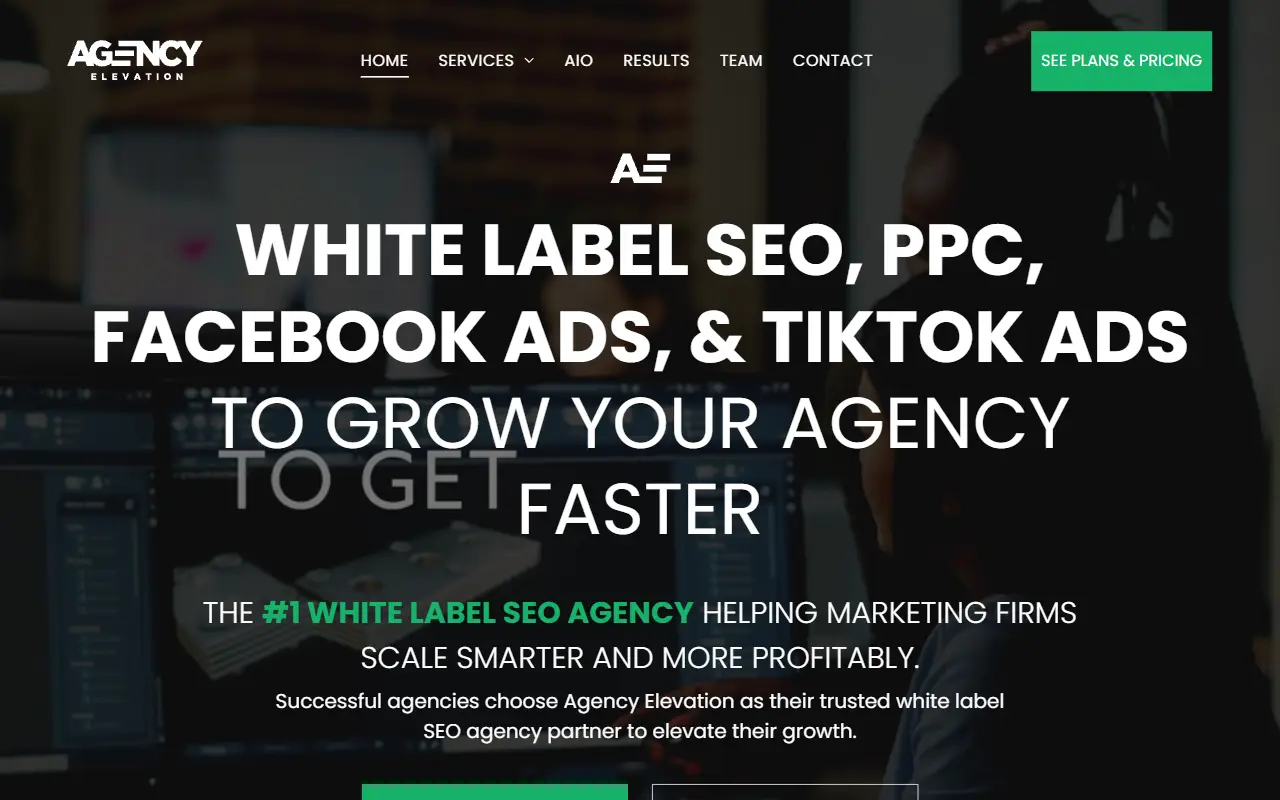
Published cost: The Agency Elevation pricing page lists white label AIO, its organic visibility plan, at $429, $649 and $859 for 6, 12 and 18 targets. White label PPC, Facebook and TikTok ads start at $499 per account per month at one account. The per-domain SEO tiers and the $1,000 monthly minimum it published earlier in 2026 are no longer on the page.
Each AIO plan covers onsite optimisation, schema markup, content, Google Business Profile work, citations and backlinks, delivered under your agency's name. Pricing is by target count rather than by domain, so ask what counts as one target before you quote a client.
Best for: Agencies that want AI search and local visibility work at a published price per plan.
Trade-offs: The homepage still sells white label SEO, but the pricing page no longer lists a plain SEO plan, so check the AIO deliverables against what your client expects from an SEO retainer, or ask for an SEO quote. Ads accounts are priced on top.
2. FATJOE: supply priced per placement
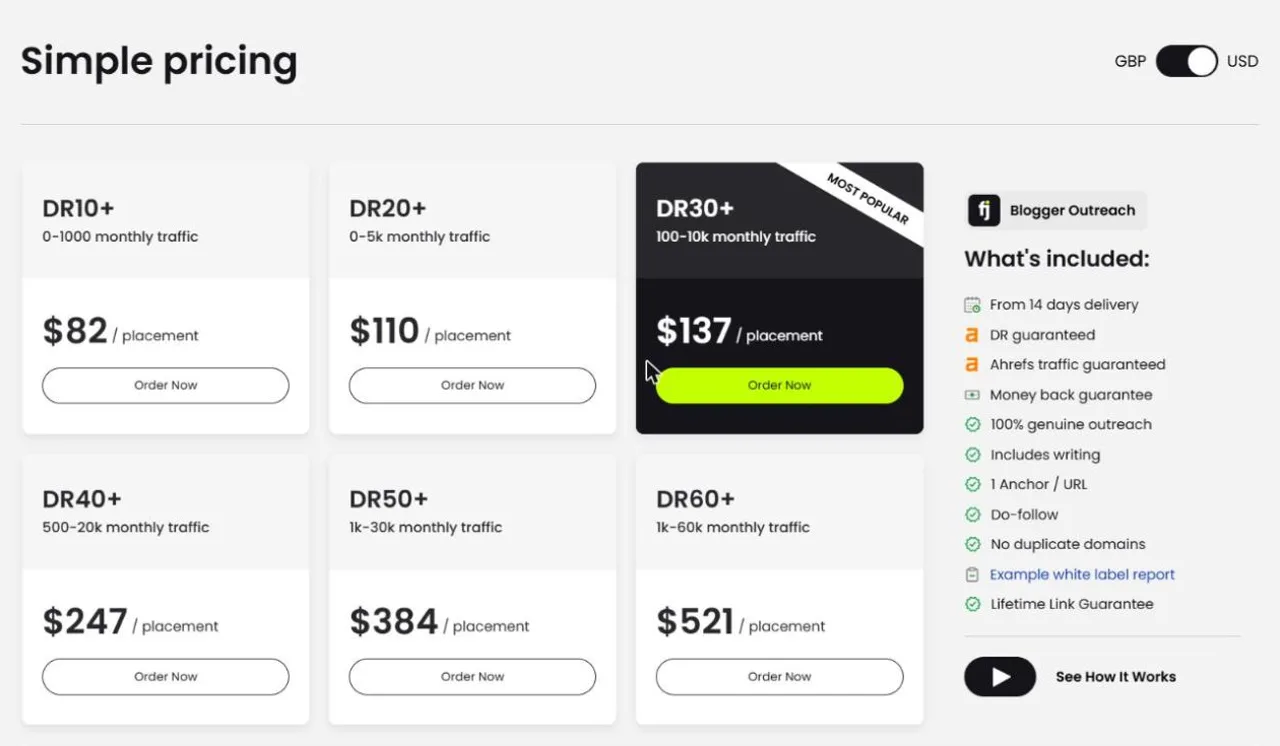
Published cost: From $82 per placement at the lowest tier (DR10+), rising to $521 at DR60+, on the FATJOE blogger outreach page (checked 9 November 2026). Its reseller FAQ offers an unbranded CSV report you can pass on as your own.
FATJOE is a supply marketplace rather than a fulfilment partner. You order placements, content or audits as individual units through a dashboard, unbranded, and resell them however you like. Because it is genuinely pay-as-you-go, it handles the lumpy demand that kills minimum-commitment deals: no client this month means no bill this month.
Best for: Agencies with irregular client demand, or anyone who wants to test a supplier with a single order rather than a contract.
Trade-offs: You own the targeting entirely, so the discount is only a discount if someone on your team can tell a good placement from a bad one. Pricing rises by authority tier, which is the model we argue against below. Our full FATJOE review has the tier-by-tier detail.
3. The HOTH: published tiers, reseller terms separate
Published cost: HOTH X, its managed SEO service, is published at $1,000 per month (Starter), $2,500 (Starter Plus), $5,000 (Business) and $10,000 (Enterprise), each with a dedicated SEO manager.
Worth being precise here, because a lot of listicles are not: HOTH X is The HOTH's own managed service, not its white label offer. White label is available through a separate reseller program, so the published tiers tell you what the work costs at retail rather than what you would pay as a reseller. That is still useful, because it anchors what your client would pay going direct.
Best for: Agencies that want a supplier with published numbers somewhere in the relationship, and a productized catalogue underneath.
Trade-offs: You need to run the reseller conversation separately to find your actual cost. See our HOTH pricing breakdown and HOTH review.
4. SEOReseller: scoped by keyword count
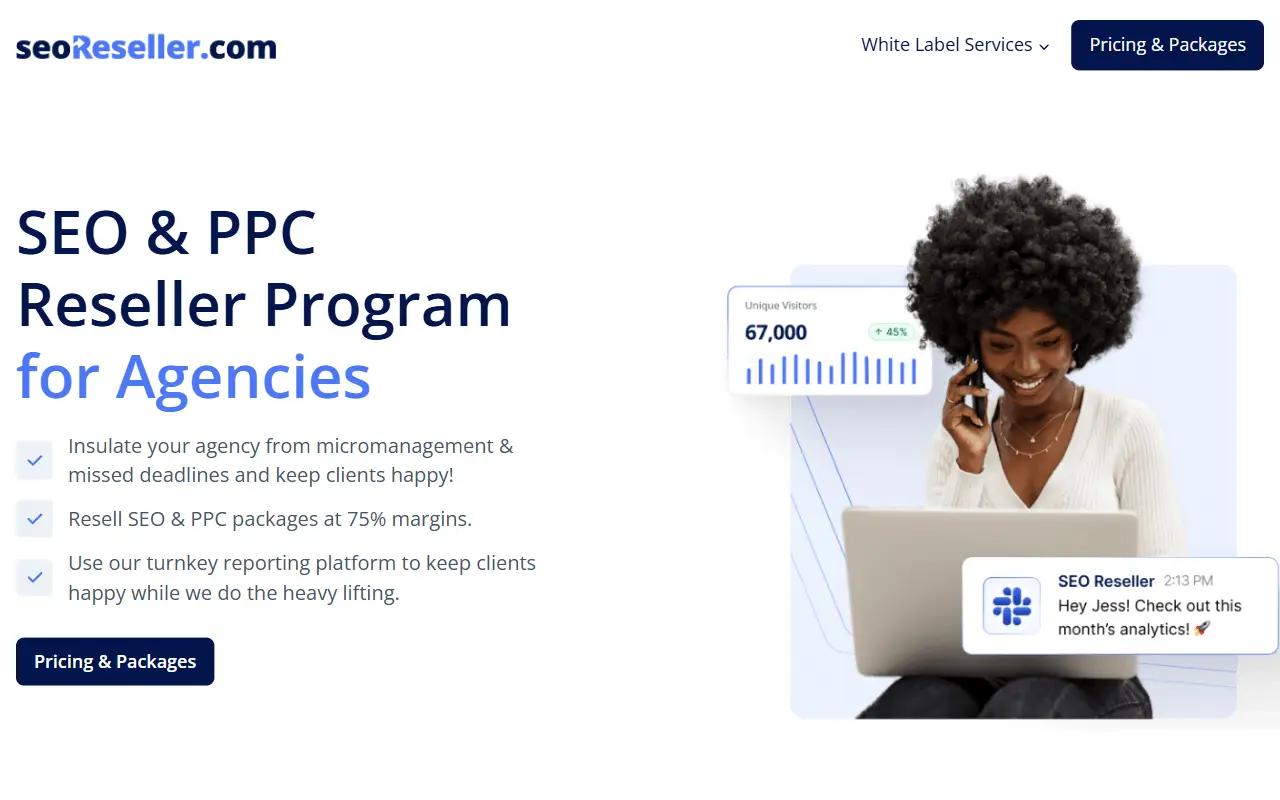
Published cost: Not published. The SEOReseller white label SEO page lists the packages without prices.
SEOReseller sells three white label packages scoped by keyword count: SEO Plus at 10 keywords, SEO Premium at 20, and SEO Prime at 30. Each includes monthly reporting, link building, on-page and technical work and audits, with keystone content generation from Premium upwards. There is a white label reporting dashboard on top. To brand your own reports instead, see white label SEO report tools and prices.
Best for: Agencies whose clients think in keyword targets, since the packages map cleanly onto that conversation.
Trade-offs: Keyword count is a scoping convenience, not an outcome. Ten keywords in a soft niche is a different job from ten in a hard one, priced the same. No public pricing, so budget only after a call.
5. Semify: built around volume
Published cost: Not published. The Semify pricing page states "Custom Price Based on Volume" across all four service lines.
Semify sells white label SEO, PPC, Facebook and TikTok ads to what it describes as resellers and enterprise organisations. The volume framing is honest about who the product suits: this is set up for agencies bringing a book of clients rather than a first one.
Best for: Established agencies with enough client volume to make a custom rate worth negotiating.
Trade-offs: Nothing published in any tier, so there is no way to sanity-check whether you got a good deal without shopping it against a competitor who also will not publish.
6. DashClicks: software first, fulfilment attached
Published cost: DashClicks Pro at $199/mo for the software, or $1,788 a year. Fulfilment access is free with no software subscription required, and you pay per service used, with those prices visible inside the dashboard rather than on the pricing page.
The product here is really the platform: a white label client dashboard, reporting and a fulfilment catalogue covering SEO, ads, backlinks, content and listings. Splitting the software fee from the fulfilment cost is a genuinely different structure from everyone else on this list. If you want tools that automate the SEO work itself rather than resell it, see our list of automated SEO software.
Best for: Agencies that want a branded client-facing dashboard as much as they want the SEO work.
Trade-offs: Per-service pricing sitting behind a login means you cannot compare it against SEO Vendor's published starting prices without signing up first. The $199 software fee is a fixed cost before any client work.
7. SEO Vendor: starting prices published by series
Published cost: Its white label SEO page lists monthly starting prices: i-Series (Value SEO) from $99, S-Series (National) from $260, X-Series (Local) from $299, SC-Series (National+) from $429, XC-Series (Local+) from $499 and M-Series (Enterprise) from $999. Month-to-month billing costs more on some series, for example $108 instead of $99 on the i-Series.
SEO Vendor splits its white label offer into series by market: X and XC for local, S and SC for national, M for enterprise and i for leaner budgets, with GEO campaigns sold separately. The local-versus-national split is a sensible way to scope, because those are genuinely different jobs.
Best for: Agencies serving a mix of local and national clients who want the scoping difference reflected in the product.
Trade-offs: The prices are starting points, and the page says deliverables and billing differ by plan, so confirm the scope before you quote. The series naming takes a while to map onto what you actually sell.
8. Boostability: built around small business volume
Published cost: Not published on the Boostability homepage.
Boostability offers four paths: reseller partners taking white label fulfilment, referral partners, strategic partners and direct small business sales. Its centre of gravity is affordable SEO for small businesses and local search, which shapes what the fulfilment is good at.
Best for: Agencies whose book is mostly small local businesses at modest monthly budgets.
Trade-offs: If your clients are B2B or national, an SMB-volume fulfilment engine is a poor match for the work. Pricing requires a conversation.
Seven questions before you sign
Ask these in writing. The answers matter more than the rate card, and the ones a provider won't put in an email are the ones to price in.
- What does the price do when the client doubles the volume?
- Will anyone from your side ever contact my client directly?
- What's the replacement policy if a link is removed, and for how long?
- Are placements disclosed as sponsored on the host site?
- How is a site qualified beyond its authority score?
- Can I see the target list before you deliver?
- If a client is penalised over a placement you sourced, who carries it?
The first one decides your margin. Per-placement pricing is linear, so your cost rises exactly as the account you worked hardest to grow gets bigger. In fulfilment deals, also pin down what happens to the account if you stop paying, because the provider holds the delivery relationship and in some arrangements the assets too.
Question five protects your agency
Your name is on the reports, so your name is on the links. That transfer of risk is the part of the deal that gets least attention in the sales process.
Most providers on this list price link placements in authority bands, because a band makes a clean rate card. It is a poor predictor of anything. Domain Rating describes a domain's overall link graph, not whether one specific page sends your client a reader who converts. A high-authority page nobody reads is worth less than a modest page whose audience is the client's buyer.
So ask one question before signing: will you show me the specific sites, before placement, and what traffic those pages actually get? A provider comfortable with that is selling you work you can inspect. A provider who will only quote authority tiers is asking you to resell something you cannot see, under your own brand. We make the fuller case in relevant backlinks.
What the contact data looks like underneath
When you resell outreach, the deliverability is yours. Bounces land on your client's domain and the complaint email arrives at your agency. It is worth knowing how rough the raw material is before you agree a volume target with a supplier.
We verify every address our agent finds on a real blog before anything is sent. Across 17,507 verified addresses, measured to 25 August 2026:
| Verification result | Share | What it means |
|---|---|---|
| Valid | 43.6% | Safe to send |
| Catch-all | 34.8% | Accepts everything, so it proves nothing |
| Invalid | 17.1% | Would have bounced |
| Unknown | 4.5% | Could not be checked |
Just over one address in six scraped from a live blog is already dead, and only 43.6% verify clean. A further 27.1% are role inboxes rather than a named person. A supplier sending to unverified lists at volume is therefore shipping a bounce rate near 17% straight onto a domain with your name on the report.
For comparison, our own send bounce rate across 11,477 attempts is 2.8%, and that gap is almost entirely verification rather than better targeting. So the question for any white label supplier promising volume is a simple one: do you verify before sending, and will you show me the bounce rate on the last client like mine? Our full working is in cold email bounce rate.
If you would rather keep the work in-house
Every option above adds a supplier between you and the client's results, and takes a cut for it. That is a reasonable trade when the alternative is hiring. It is a worse trade when the only gap is outreach capacity.
MentionAgent is $99/mo flat per sending inbox. The agent finds blog posts in the client's niche, looks up the author's verified email, writes a pitch tied to that specific post, and sends it once you approve it in the dashboard or Telegram, or on its own once you turn on auto-send. There are no per-contact fees and no per-link pricing, so you can quote a retainer without a rate card negotiation.
It is not a fulfilment partner and it will not run a client's technical SEO. It replaces the outreach line item, at a flat cost you can build a margin on top of without a rate card negotiation. Agencies running it per client is exactly the shape our white label link building page works through.
How to pick
Decision tree
- Need to quote a client this week? → SEO Vendor, starting prices published per series.
- Want AI search work at a published price? → Agency Elevation.
- Demand is irregular and you want to pay per placement? → FATJOE.
- Want a branded client dashboard as much as the work? → DashClicks.
- Clients think in keyword targets? → SEOReseller.
- Bringing real volume and want a negotiated rate? → Semify.
- Mixed local and national book? → SEO Vendor.
- Mostly small local businesses? → Boostability.
- Only the outreach is missing? → MentionAgent at a flat $99/mo.
Add outreach to your agency without a wholesale contract
$99/mo flat per sending inbox. The agent finds the posts, finds the author, writes the pitch and follows up with people who reply. You approve sends, or turn on auto-send.
Start FreeFrequently asked questions
What does a white label SEO company do?
Each month it does the SEO work for a client you sold it to: keyword research, on-page fixes, content and links, then a report with your logo that you pass on. You set the retail price and own the relationship, and the client should deal only with you. A supply company does less, selling single units such as placements or articles for campaigns you run yourself.
What is a white label SEO agency?
A white label SEO agency does the work and lets you sell it under your own brand. The client sees your name on the reports and invoices. You pay wholesale and set your own retail price. Two quite different products get sold under that label: full fulfilment, where the provider runs the campaign, and supply, where they sell you placements or content and you run it.
What is an SEO reseller program?
A program that lets you sell SEO work you don't deliver. It covers three different deals: fulfilment (whole campaigns run behind your brand), supply (unbranded placements or content you mark up) and referral (a commission for an introduction, no delivery). The margin, risk and workload differ in each, so sort a provider into one before comparing prices.
How much does white label SEO cost?
Most providers do not publish a figure. SEO Vendor is the clearest exception, listing white label starting prices from $99 to $999 a month by series. Agency Elevation lists its white label AIO plans at $429, $649 and $859 by target count. On the supply side, FATJOE starts at $82 per placement with pricing rising by site authority. The HOTH publishes its managed SEO tiers at $1,000, $2,500, $5,000 and $10,000 per month, though that is its direct service rather than the reseller program.
What margin can an agency make reselling SEO?
The range quoted in the industry is a 30% to 100% markup. What matters is what survives after the account management the provider does not do: client calls, scope arguments, reporting commentary and chasing approvals. Those hours are yours and they are not in the wholesale price. Our white label link building page works the maths through properly.
Should I pick a provider that hides its pricing?
You can, but count the cost. Without a wholesale number you cannot price your own retainer before a sales call, and you cannot compare two providers without sitting through two sales processes. Five of the eight here keep their white label pricing behind a form, a login or a quote. It is normal in this category and it is still friction when you need to quote a client this week.
Is white label SEO risky for my agency?
The reputational risk transfers to you completely, because your name is on the work. If the provider places links on weak sites, your client's domain carries that and your agency gets the call. Ask what the provider will show you: the specific sites, before placement, and whether those pages get real traffic. A provider that reports only authority tiers is asking you to resell something you cannot inspect.