Link Building for Ecommerce: Where Store Links Come From (2026)
In the product roundups we checked, big publishers marked every buy link sponsored or nofollow. The followed links to stores came from small niche blogs, a store's own buying guide and an endorsement list.
Point links at: product pages. When a roundup links to a store, it links the product.
Before you pitch: check the page's links, so you know whether yours would be followed.
We read the buy links in 15 product roundups ranking in Google's top 10 for "best [product]" searches. 9 marked every buy link nofollow or sponsored. Only 4 gave a followed, direct link to a brand's own store.
Amazon: 10 of the 15 linked to Amazon, and 5 sent most of their buy links there.
Checked 2 November 2026. Method.
What 15 ranking roundups did with their buy links
For product searches from running shoes to dog food, we took the editorial articles in Google's top 10 and read every buy link in their HTML: where it went and its rel value.
| Roundup | Search | Buy links marked nofollow or sponsored | Buy links to Amazon | Followed direct links to a brand's store |
|---|---|---|---|---|
| runnersworld.com | best running shoes | 100% | 7% | 0 |
| bonappetit.com | best coffee grinder | 100% | 0% | 0 |
| allure.com | best sunscreen for face | 100% | 0% | 0 |
| goodhousekeeping.com | best dog food | 100% | 79% | 0 |
| cnn.com (Underscored) | best office chair | 100% | 38% | 0 |
| cntraveler.com | best travel backpack | 100% | 0% | 0 |
| packhacker.com | best travel backpack | 100% | 14% | 0 |
| packhacker.com | best water bottle | 100% | 54% | 0 |
| outdoorgearlab.com | best water bottle | 100% | 55% | 0 |
| coffeechronicler.com | best coffee grinder | 97% | 67% | 0 |
| coffeekev.com | best coffee grinder | 88% | 6% | 0 |
| nomadsnation.com | best travel backpack | 20% | 0% | 3 |
| bottlepro.net | best water bottle | 1% | 95% | 2 |
| kaldiscoffee.com | best coffee grinder | 0% | 14% | 6 |
| skincancer.org | best sunscreen for face | 0% | 0% | 246 |
Runner's World, Bon Appetit, Allure, Good Housekeeping, CNN Underscored and Conde Nast Traveler marked every buy link. The followed, direct links to brand stores came from four places: a travel blog, a water bottle blog, a coffee roaster's grinder buying guide and the Skin Cancer Foundation's list of products that earned its Seal of Recommendation.
So count a big roundup as a sales channel and a mention, not a link. Google asks publishers to mark "advertisements or paid placements (commonly called paid links)" with rel="sponsored" (Google Search Central). More on what those links do in do affiliate links help SEO.
Where ecommerce links come from
1. Niche blogs that compare products in your category. Two of the four sources of followed store links in our sample were small blogs like these. A third was a coffee roaster's grinder guide that linked each grinder maker's own store. Pitch posts that already compare products like yours, with a reason yours belongs. Our guide to listicle outreach covers the pitch.
2. Endorsement lists. The Skin Cancer Foundation's list linked to the recommended products' own pages, with no nofollow. Look for the equivalent in your category: a trade association, a testing body or an awards list.
3. Brands you stock and stores that stock you. If you resell, ask each brand to list you on its "where to buy" page. If you make the product, ask stockists to link to it.
4. Something worth citing. A size guide, test results or survey data gives writers a reason to link to you rather than a retailer. See digital PR.
5. Mentions without a link. When a site names your brand or product but does not link, ask for the link. See unlinked brand mentions.
6. Your competitors' links. Look up which pages link to the stores you compete with, using the free version of Ahrefs' Backlink Checker, and pitch the same pages. A link on them that has gone dead is an opening: see broken link building.
Which pages to point links at
Product pages for roundup links. In the median roundup that linked to a brand's own store, every one of those links went to a product page. Our data covers roundups only: for a broad search like "trail running shoes", the page you want to rank is a category page, so link to it from your own guides and product pages.
That makes the product URL the thing that collects links. If you rename a product or move it, redirect the old URL, or the link lands on a 404. If a product is discontinued, redirect it to the closest one you still sell.
Before you pitch a roundup
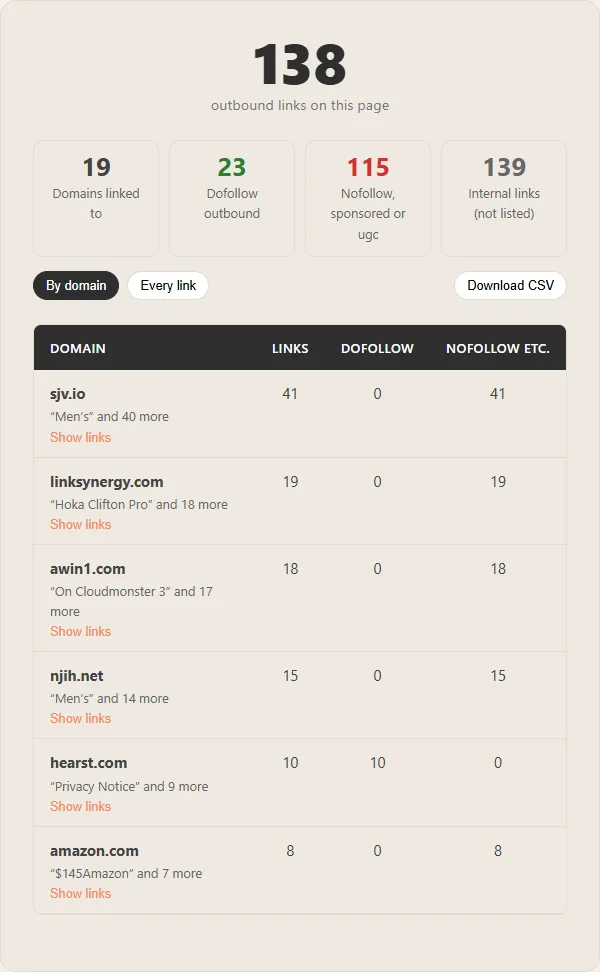
- Check the links on the page. The outbound link checker lists every external link with its
relvalue. If every store link is sponsored, yours will be too. - Ask for the product page, not the homepage.
- Look at how the page earns. 9 of the 15 roundups sent some buy links through an affiliate network or a tracked redirect. A writer paid that way may only list products they can earn on, so an affiliate program can be what gets you in.
Finding those blogs and writing to each author is the slow part. MentionAgent searches for blog posts in your niche, finds the author's email, writes a pitch for each post and sends it from a separate sending domain. You can tell it in plain English which sites to skip. Emails can wait for your approval, or send on autopilot. Our guide to link building tools compares it with the alternatives.
Pitch the blogs that compare products like yours
MentionAgent finds the posts in your category, looks up the authors and writes a pitch for each one. Check each email first, or let it send on autopilot.
Start Getting Mentioned On AutopilotFrequently asked questions
Is a big roundup worth it if the link is sponsored?
Yes, as a sales channel and a mention. Readers of a roundup are ready to buy. Just do not count it as a followed link: in our check of 15 ranking roundups, 9 marked every buy link nofollow or sponsored, including Runner's World, Bon Appetit, Allure and Good Housekeeping.
Which pages should an online store build links to?
Product pages first. In the median roundup we checked that linked to a brand's own store, every one of those links went to a product page. Keep product URLs stable, and redirect an old one when a URL changes so the link does not land on a 404.
Can a store pay to be included in a roundup?
Some publishers sell placements. Google asks publishers to mark links that are advertisements or paid placements with rel="sponsored", so a paid placement should not pass ranking credit. Treat it as advertising and judge it on sales. See do nofollow links help SEO.
How do I find roundups and blogs to pitch?
Search "best [your product]" and "[your product] review", skip retailers and big publishers, and list the blogs and enthusiast sites that compare products in your category. Check each page's links before you pitch, so you know whether a link would be followed.
Does link building still work for online stores?
Yes, but rarely through big publishers. In our sample, 9 of 15 ranking roundups marked every buy link nofollow or sponsored, and the followed links came from niche blogs, a store's buying guide and an endorsement list. More in are backlinks still important.
How much does ecommerce link building cost?
It depends on how the links are earned: your own outreach costs time, agencies charge retainers and marketplaces charge per placement. Our guide to what backlinks cost converts each model to a per-link price.
Method
On 2 November 2026 we took Google's US top 10 (via Serper) for eight searches: best running shoes, best coffee grinder, best sunscreen for face, best dog food, best office chair, best water bottle, best travel backpack and best mattress. We dropped big retailers, social networks and video, fetched each remaining page's HTML, and kept the 15 articles with five or more buy links in it. They come from seven of the searches: no mattress article made the cut. One coffee grinder roundup timed out twice and is not in the sample.
A buy link goes to Amazon or another large retailer, through an affiliate network, or to a store's product or collection page. A followed, direct link to a brand's store has no nofollow, sponsored or ugc value and no affiliate redirect. Pages that add buy buttons with JavaScript, Wirecutter among them, show almost none in their HTML and fell below the five-link floor. Each article counts once in the shares above.